


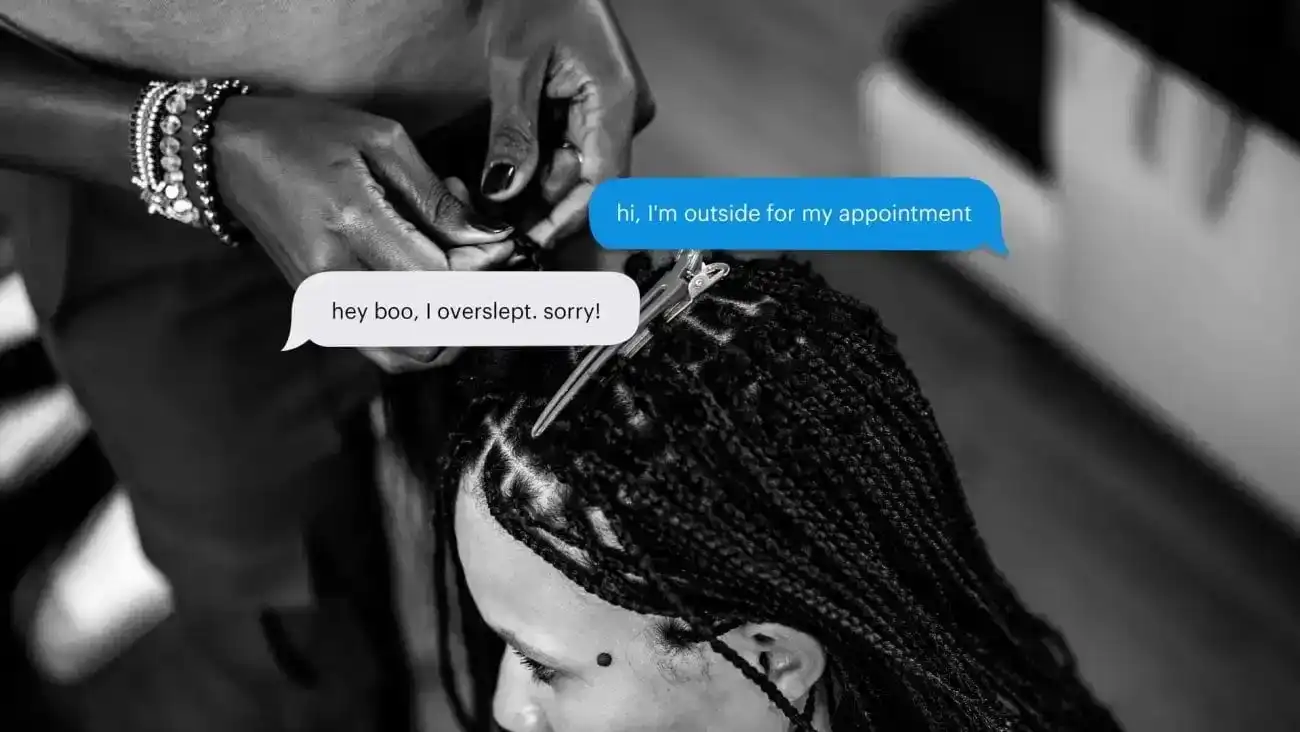
If you looked at my group chat in the summer of 2023, you’d think I had just gone through a breakup. Texts to the tune of “Are you okay?” and “I can’t believe this is happening to you” came in rapid succession. The situation was not one of heartbreak…at least not the romantic kind. I’d just been stood up by an Instagram hairstylist.
I’m not the only one with the “IG hairstylist” blues. Countless other Black women have had negative experiences with a hairstylist they found on social media. By my estimation, this pattern started about two years ago and is now damn near a phenomenon. #IGhairstylists has over 4.5 million views on TikTok and is filled with thousands of videos of Black women sharing the unprofessional experiences they’ve had. There’s even a whole Instagram account dedicated to airing grievances against these hairstylists (and other businesses) called Official Raw Reviews.
While some of the submissions on the account are positive, many highlight experiences similar to that of 22-year-old Joanna Georges, who went viral on TikTok after sharing that she sued a stylist who went MIA at the time of her appointment and refused to return the $100 deposit required to book. “I had a feeling she was going to oversleep,” says Georges. After waking up at 8 a.m. and walking more than 20 minutes to meet a braider she’d found on Instagram, Georges was left standing outside a Jersey City apartment for over an hour before angrily walking home. (The claim is in the process of being resolved out of court. The stylist did not respond to the request for comment.)
Using Instagram to promote your business in some capacity has practically become a requirement, but in the Black hairstyling space, there’s been the emergence of a new type of stylist whose social presence is especially notable. These Instagram hairstylists have large followings, sometimes boast celebrity clients, and almost always have a ring light in their setup. The line between a hairstylist with a sizable Instagram following and the Instagram hairstylists who are being criticized online can be murky, but the consensus is that the former has earned their following by providing high-quality services to their clients, while the latter started with creating trendy hairstyling-related content, and then began booking clients. Videos and comments online suggest that this increased emphasis on building a strong brand on social media has come at the expense of quality customer service and community building — historically, two essential pillars of the Black hairstyling industry.
The Instagram hairstylists that people are taking issue with are known to have stringent policies, high prices, rude customer service, and straight-up scammer tendencies. Georges’s story went viral because she took legal action against the stylist, which is rare, but many stories like hers fly under the radar. In one submission on Official Raw Reviews, an anonymous client shared that a hairstylist in Brooklyn also missed her appointment with no notification. “I was sitting there for almost 45 minutes and she wasn’t answering the door, my text messages, or her DMs,” says the client. “I drove 30 minutes from Queens in traffic and you don’t even have the decency to say you can’t make it to my hair appointment?” The stylist commented under the submission explaining that she “didn’t have access to my phone,” and wrote the client an apology before refunding the money. Another submission details an incident where a client booked an appointment with a stylist in Brooklyn for starter locs only to have the stylist reschedule it four times. On the third rescheduled date, the client says she stood outside the shop, “alone in the rain with no signs of anybody…looking stupid.” The stylist finally called the client back after an hour asking to reschedule yet again. The client accepted but was left hanging a fourth time.
Hairstylists aren’t the only ones catching heat — the iron is hot on both sides. Some hairstylists online say clients have lost respect for all that goes into hairstyling. “I’ve had clients come an hour late and still expect me to do their hair,” says New York City-based stylist and braider Shanna St. Cyr (who, with her 13.1K followers and page of rules for clients to read before booking, would be considered an Instagram hairstylist).
In this climate, a hair appointment can be just as daunting as a first date, where a “hey boo” message from your stylist elicits anxious butterflies — and not the good kind. When did getting your hair done become so complicated?
The origins of the Instagram hairstylist
Let’s rewind to early pandemic times when many businesses, including salons, closed their doors and Black women were forced to learn how to do their hair at home — a skill that had been passed down through generations but somehow has gotten lost through the years. During lockdown, many Black women discovered they were gifted with our ancestors’ ability to turn coils into braided masterpieces. At a time when people were also strapped for cash, some of these women turned their newfound skill into a side hustle and used social media as their main marketing tool — and the Instagram hairstylist was born. Stylists like St. Cyr and Brooklyn-based braider turned salon owner Xia Charles (who has a following of nearly 425K on Instagram) started doing hair in their homes for friends and family while slowly building their brands on social media.
The Instagram hairstylists that people are taking issue with are known to have stringent policies, high prices, rude customer service, and straight-up scammer tendencies. Georges’s story went viral because she took legal action against the stylist, which is rare, but many stories like hers fly under the radar. In one submission on Official Raw Reviews, an anonymous client shared that a hairstylist in Brooklyn also missed her appointment with no notification. “I was sitting there for almost 45 minutes and she wasn’t answering the door, my text messages, or her DMs,” says the client. “I drove 30 minutes from Queens in traffic and you don’t even have the decency to say you can’t make it to my hair appointment?” The stylist commented under the submission explaining that she “didn’t have access to my phone,” and wrote the client an apology before refunding the money. Another submission details an incident where a client booked an appointment with a stylist in Brooklyn for starter locs only to have the stylist reschedule it four times. On the third rescheduled date, the client says she stood outside the shop, “alone in the rain with no signs of anybody…looking stupid.” The stylist finally called the client back after an hour asking to reschedule yet again. The client accepted but was left hanging a fourth time.
Hairstylists aren’t the only ones catching heat — the iron is hot on both sides. Some hairstylists online say clients have lost respect for all that goes into hairstyling. “I’ve had clients come an hour late and still expect me to do their hair,” says New York City-based stylist and braider Shanna St. Cyr (who, with her 13.1K followers and page of rules for clients to read before booking, would be considered an Instagram hairstylist).
In this climate, a hair appointment can be just as daunting as a first date, where a “hey boo” message from your stylist elicits anxious butterflies — and not the good kind. When did getting your hair done become so complicated?
The licensing of it all
Social media has given anyone with the ability to do hair the visibility to market themselves as a hairstylist, but it takes more than skilled hands to be a good stylist — and US law agrees. “All 50 states require beauty professionals to be licensed,” says Myra Irizarry, director of government affairs for the Professional Beauty Association. As a part of training at cosmetology school, students learn to wash, blow-dry, cut, and braid hair (though the curriculum on braiding doesn’t extend to many of the styles that are popular in the Black community). This training is meant to enhance the craft of stylists and also give them the proper education to ensure that they don’t compromise the health and safety of their clients.
Most Popular
- WELLNESS Each Zodiac Sign’s Unique Personality TraitsBY ALIZA KELLY
- HAIR Halle Bailey’s New Curly Bob Is Not Your Average Curly Bob BY KARA NESVIG
- HAIR Nicole Kidman Changed Her Hair Color — and, Apparently, Her Entire VibeBY MARCI ROBIN
On top of the financial asks, many of these policies from Instagram stylists require clients to do some of their own styling before they even set foot in the salon. Growing up in the suburbs of Westchester, my visits to the salon would always include a wash and blow-dry. Even when my mom would take me to an auntie in the Bronx to cut costs, they’d always have a single wash station to cleanse my hair before blow-drying and braiding. Some of these stylists are charging upwards of $250 to $300 for a service and they don’t even wash or blow-dry a client’s hair — not to mention that sometimes the hair extensions aren’t even included in the price.
Not offering a full service, yet charging for one, perpetuates the feeling that some of these stylists prioritize making money over maintaining a strong relationship with their clients. Without a wash and blow-dry, stylists spend less money on shampoo and conditioner and it gives them time to fit in more clients — though a service like braiding does take upwards of four hours. For some stylists, not offering a full service is due to limited space and resources. “I don’t wash hair right now because of how I’m situated, but I believe if a client needs their hair washed, that client should have their hair washed,” says St. Cyr, who does hair in a studio area of her apartment that doesn’t have a hair-washing sink or a blow-dry station. Ultimately, it’s up to the client to decide if a stylist’s work is worth the price of a full-service salon without the full-service benefits.
Where do we go from here?
Again, problems arise when some stylists take advantage of the trust and intimacy in the community and dishonor clients by refusing to return deposits, canceling appointments at the last minute, and not giving our hair the full care and attention it deserves — all while charging an arm and a leg. In this messy state of affairs where clients feel slighted and stylists feel misunderstood, business is still booming for Instagram hairstylists. But do any of these complaints really matter? Yes, says everyone I spoke to. Outside the Black community, our hair is policed, politicized, and ridiculed, so we have to continue to be that safe space for each other. Sitting down with someone who looks like you and understands your hair can feel like a huge sigh of relief.
The resolution will require a mutual understanding in the Black community: We need to level set, first internally, then with each other. While it may be tempting to browse Instagram and TikTok looking for a stylist with a big following who can do all the trendy styles, it’s in your best interest to prioritize credentials. “Someone having a million followers doesn’t mean they’re a great hairdresser,” says Blissett Williams. Finding and booking with independent stylists through sites like Styleseat adds a layer of accountability. Stylists must be licensed to register on the site and you’ll have access to their full-service menu and reviews from other clients.
Be prepared to pay a commensurate price for a licensed stylist. “We have to pay to stay educated and we have to pay to keep the salon clean, so our prices will reflect that,” says Charles. Well-established Instagram stylists like Charles and St. Cyr charge between $300 and $700 for popular box braid styles, in part, because they have years of experience (and a New York State cosmetology license) that warrants a higher rate, and because rent in New York City is so expensive. In the same way you might hunt for reviews of a restaurant before reserving a table, approach finding a stylist with the same energy. Reach out to past clients featured on the stylist’s page for intel or get stylist recommendations from people you know and trust.
Now to the other side of the red table. Stylists in the Black community need to reconnect with the heart behind hairstyling: making people feel beautiful. A change as simple as communicating your policies with kinder language can make all the difference. Having a list of don’ts at the top of the booking site in all caps or bolded in red is like scolding your clients the moment they walk in. “People want the same qualities of a good friend in a stylist: someone you can communicate with, be transparent with, and that doesn’t make you feel that any question is ridiculous,” says Jonathan Matais, a stylist at Blissett Williams’s salon.
While there is the possibility for rude customer service in every industry, hair is just way too personal to be letting someone play in your curls while sucking their teeth at you. When you’re spending upwards of three hours in a salon chair, your stylist can turn into a therapist and confidant and for many Black women, that’s a big part of the experience. “I would go back to my braider after months and she’d ask me, ‘How’s everything with so-and-so,’ and I’m like, ‘How do you remember that?’ says 31-year-old Nikki Abraham, who gets her hair braided by Charles. “She feels like a friend. I’m sure she has that relationship with many of her clients, so I know I’m not special—but I feel special.”
Read more about Black hairstyling:
- A New Law Requires All Cosmetology Students in New York State Learn to Style Textured Hair
- This Wig Designer Is Trying to Fix Broadway’s Hair Inclusivity Problem
- 35 Black-Owned Hair-Care Brands That Should Be on Your Radar

